
Cancer Surgery vs Chemotherapy What’s the Difference
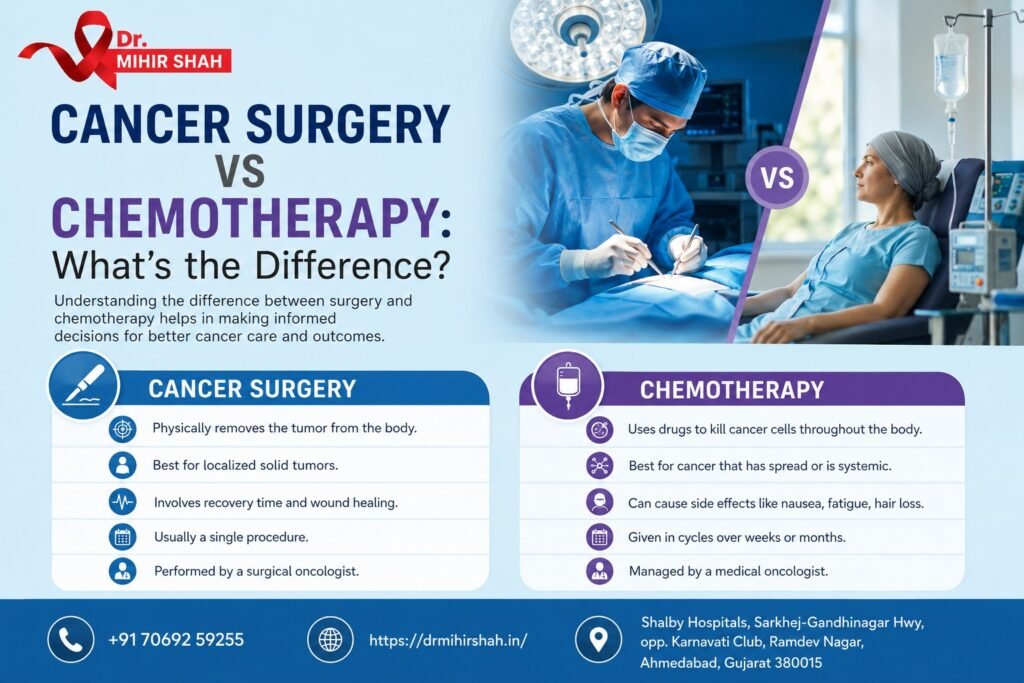
Cancer Surgery vs Chemotherapy: What’s the Difference? Introduction When someone is diagnosed with cancer, one of the first questions that comes up is: What kind of treatment will I need? For many people, the two options that immediately come to mind are surgery and chemotherapy. Both are widely used in cancer care, but they work very differently and serve different purposes. Understanding the distinction between the two can help patients and their families have more informed conversations with their medical team. If you are looking for guidance from the best surgical oncologist in Ahmedabad, this article will walk you through the key differences in a straightforward way. What Is Cancer Surgery? Cancer surgery is a procedure in which a surgeon physically removes a tumour or cancerous tissue from the body. It is one of the oldest forms of cancer treatment and, in many cases, remains the most effective way to eliminate a localised cancer — one that has not spread significantly beyond its original site. Surgery can be used in several ways depending on the situation: Curative surgery: The goal is to remove the entire tumour and achieve a cancer-free outcome. This is most effective when the cancer is caught early and has not spread to other organs or lymph nodes. Debulking surgery: When the entire tumour cannot be safely removed, the surgeon removes as much of it as possible. This is often followed by chemotherapy or radiation to treat what remains. Preventive surgery: In some high-risk cases — such as patients with BRCA gene mutations — surgery may be recommended to remove tissue before cancer develops. Diagnostic surgery: A biopsy or exploratory procedure to confirm whether a growth is cancerous and, if so, what type of cancer it is. Palliative surgery: Performed not to cure, but to relieve pain or symptoms caused by the tumour — for example, removing a mass that is pressing on a nerve or blocking a passage. Modern cancer surgery has evolved significantly. Many procedures today are performed laparoscopically — through small incisions using a camera and specialised instruments — which means faster recovery, less scarring, and fewer complications compared to traditional open surgery. What Is Chemotherapy? Chemotherapy is a systemic treatment — meaning it travels through the bloodstream and affects the entire body, not just one specific area. It uses powerful drugs to destroy cancer cells or slow their growth by targeting cells that divide rapidly. Unlike surgery, which removes a physical mass, chemotherapy works at the cellular level. It is particularly useful when: Cancer has spread (metastasised) to multiple parts of the body The cancer cannot be safely reached or removed through surgery There is a risk that microscopic cancer cells may remain after surgery The cancer type responds well to drug-based treatment, such as certain blood cancers Chemotherapy can be administered orally (as tablets) or intravenously (through a drip), and is typically given in cycles — periods of treatment followed by rest to allow the body to recover. Side effects such as nausea, fatigue, hair loss, and reduced immunity are common because chemotherapy affects healthy rapidly dividing cells as well as cancer cells. Key Differences Between Surgery and Chemotherapy The simplest way to understand the difference is this: surgery treats cancer locally, while chemotherapy treats it systemically. Surgery removes what is visible and physically present. Chemotherapy targets what cannot be seen — cancer cells circulating in the body or spread to distant organs. Here is a broader comparison: Approach: Surgery is physical and targeted. Chemotherapy is chemical and body-wide. Best suited for: Surgery works best for solid, localised tumours. Chemotherapy is preferred for cancers that have spread or those that respond well to drug therapy. Side effects: Surgery involves a recovery period with wound healing and physical restoration. Chemotherapy side effects are systemic — affecting energy levels, digestion, hair, and immunity. Duration: Surgery is a single event (or a small number of procedures). Chemotherapy runs over weeks or months in scheduled cycles. Specialists involved: A surgical oncologist performs cancer surgery. A medical oncologist manages chemotherapy treatment. Are Surgery and Chemotherapy Ever Used Together? Yes — very commonly. In fact, for many types of cancer, a combination of both approaches gives the best outcome. How they are sequenced depends on the cancer type, stage, and the overall treatment plan. Neoadjuvant chemotherapy refers to chemotherapy given before surgery. The goal is to shrink the tumour first, making it easier to remove completely during the operation. This approach is often used in breast cancer, oesophageal cancer, and some cases of colon cancer. Adjuvant chemotherapy is given after surgery to eliminate any remaining cancer cells that may not have been visible during the procedure. This reduces the risk of recurrence and is a common part of treatment plans following surgery for colon, breast, and lung cancer, among others. In some cases, radiation therapy is also added to the plan — either alongside chemotherapy, after surgery, or both. Each element of the treatment serves a specific purpose, and the combination is tailored to the individual patient. How Is the Treatment Decision Made? The decision between surgery, chemotherapy, or a combination is never taken lightly. It is based on a thorough evaluation of multiple factors: Type of cancer: Some cancers respond better to surgery (colon, breast, kidney), while others are more responsive to chemotherapy (leukaemia, lymphoma) Stage of cancer: Early-stage cancers are often surgical candidates. Advanced stages may require systemic treatment first Location of the tumour: If the tumour is near critical structures — major blood vessels, nerves, or organs — surgery may carry a significant risk Patient’s overall health: Age, fitness level, and existing medical conditions influence what the body can safely handle Patient’s preferences: Informed patients who understand their options play an active role in the final decision This is why a multidisciplinary approach to cancer care — where surgeons, medical oncologists, radiation specialists, and pathologists all discuss the case together — produces the most balanced and effective treatment plans. Questions to Ask Your Cancer