
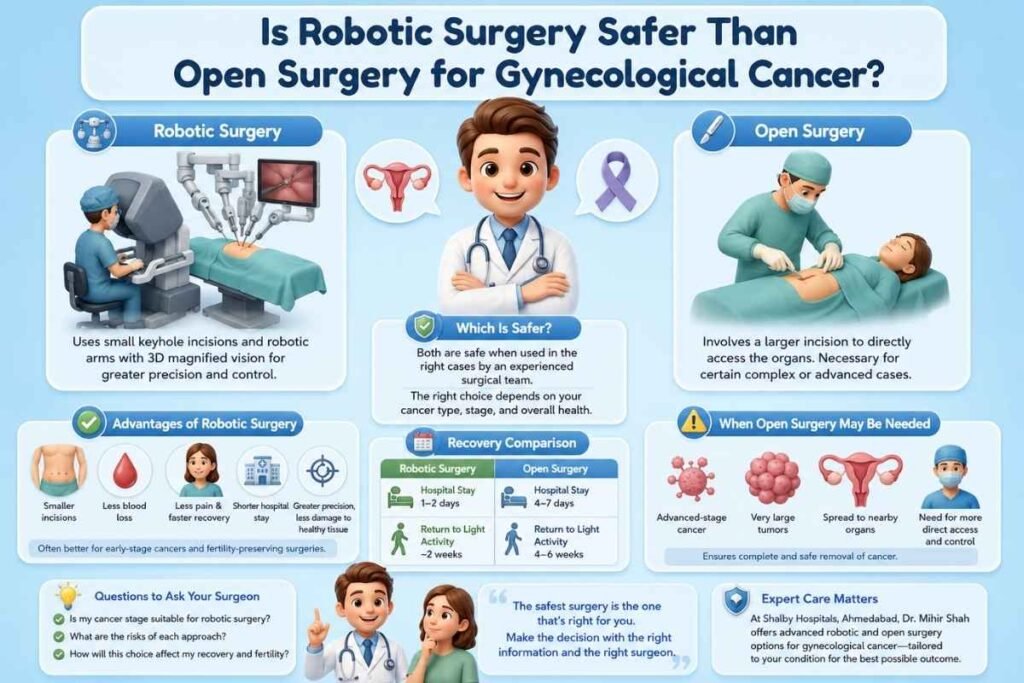
Is Robotic Surgery Safer Than Open Surgery for Gynecological Cancer?
Is Robotic Surgery Safer Than Open Surgery for Gynecological Cancer? Introduction If you’ve been recently diagnosed with a gynecological cancer, chances are your doctor has already mentioned two very different-sounding paths — robotic surgery and open surgery. And naturally, the first question that comes to mind is which one is actually safer. It’s not a simple yes-or-no answer, but understanding how the two differ can help you have a much more informed conversation with your surgeon. What’s the Real Difference Between the Two? Open surgery involves a single, larger incision that gives the surgeon direct access to the affected organs. It’s been the standard approach for decades and remains necessary for certain complex or advanced cases. Robotic surgery, on the other hand, uses a handful of small keyhole incisions. The surgeon operates from a console, guiding robotic arms with a magnified 3D view of the surgical area, allowing for finer, more controlled movements than the human hand alone can manage through a small opening. Where Robotic Surgery Genuinely Has an Edge For early-stage endometrial (uterine) cancer, cervical cancer, and selected ovarian tumours, robotic surgery tends to offer real, measurable advantages. Smaller incisions generally mean less blood loss during the procedure, reduced post-operative pain, and a shorter hospital stay compared to open surgery. Because the tools are more precise, surgeons can often work around healthy tissue with greater accuracy, which matters a lot when preserving urinary, bowel, or reproductive function is a priority — something that comes up often for younger patients hoping to preserve fertility. Why “Safer” Isn’t a One-Size-Fits-All Answer Here’s the part that often gets oversimplified online: robotic surgery isn’t automatically the better choice for every patient. Advanced-stage cancers, very large tumours, or cases involving extensive spread to nearby organs often still require open surgery, simply because the surgeon needs more direct access and control. Choosing robotic surgery for a case that genuinely needs an open approach could actually compromise the outcome rather than improve it. This is exactly why the decision should come from a detailed evaluation of your specific cancer type and stage, not a general preference for “the newer technology.” What the Research and Clinical Experience Show Across most published outcomes, robotic-assisted procedures for gynecological cancers show comparable cancer-clearance rates to open surgery in appropriately selected cases, while offering faster recovery and fewer surgical complications like infection or excessive bleeding. What robotic surgery doesn’t automatically guarantee is a better long-term survival outcome — that depends far more on how completely the cancer is removed and how early it was caught, not just the surgical technique used. What Recovery Actually Looks Like With Each Approach Patients who undergo robotic gynecologic surgery typically get back to light activity within a couple of weeks, compared to four to six weeks with open surgery. Hospital stays are also noticeably shorter — often just a day or two versus four to seven days after an open procedure. That said, recovery speed shouldn’t be the only factor guiding the decision; the priority is always removing the cancer completely and safely, with recovery time being a meaningful bonus, not the primary goal. Types of Robotic Procedures Used in Gynecological Cancer Depending on the diagnosis, robotic techniques can include a robotic hysterectomy for uterine cancer, robotic radical hysterectomy for more involved cervical cancer cases, robotic ovarian tumour removal, and robotic pelvic lymph node dissection to check whether cancer has spread. Each of these has an open-surgery equivalent, and the right choice genuinely depends on your individual case rather than a blanket rule. How Dr. Mihir Shah Approaches This Decision At Shalby Hospitals in Ahmedabad, Dr. Mihir Shah evaluates every gynecological cancer treatment in Ahmedabad on a case-by-case basis, weighing tumour type, stage, and the patient’s overall health before recommending robotic or open surgery. His approach leans toward minimally invasive and robotic techniques wherever it’s clinically appropriate, particularly when preserving reproductive function is a realistic goal, but he’s equally clear with patients about when open surgery remains the safer, more thorough option. This kind of honest, individualised assessment — rather than defaulting to whichever technique sounds more advanced — is what genuinely protects patient safety. Questions Worth Asking Your Surgeon Before deciding between the two approaches, it’s worth asking directly: is my cancer stage suitable for a robotic approach, what are the specific risks either way, and how will this choice affect recovery and future fertility if that’s relevant to you? A surgeon who takes the time to answer these clearly, rather than pushing one option, is generally the one you can trust with this decision. Making the Right Call for Your Case Robotic surgery isn’t universally “safer” than open surgery — it’s safer and more beneficial for the right cases, while open surgery remains essential for others. What actually determines your safety is an accurate diagnosis, the right technique matched to your specific cancer, and a surgeon experienced in both approaches. If you’re exploring gynecological cancer treatment in Ahmedabad, ask detailed questions, get a clear explanation of why a particular technique is being recommended for you, and don’t hesitate to seek a second opinion if something feels rushed.